Choosing the right SIP trunk capacity does not have to be complicated.
If your business has 20 employees, do you need 20 SIP trunks? What about a company with 100 employees? The answer depends on something more important than headcount: how many calls happen at the same time?
In other words, your peak call activity matters more than the total number of employees.
Understanding SIP trunk channels, concurrent calls, and expected growth can help you choose the right capacity. As a result, you can avoid paying for capacity you do not need while still handling busy periods smoothly.
In this guide, we will answer how many SIP trunks do I need, explain SIP trunk capacity in simple terms, and show you how to estimate the number of channels your business may require.
What Is a SIP Trunk?
A SIP trunk is a virtual connection that allows businesses to make and receive calls over an internet connection instead of traditional telephone lines.
SIP stands for Session Initiation Protocol. It helps establish, manage, and end communication sessions between your business phone system and the telephone network.
Unlike traditional phone lines, SIP trunking gives businesses more flexibility. You can adjust your calling capacity as your needs change.
However, there is one important distinction to understand:
A SIP trunk is not the same as a SIP channel.
A SIP trunk is the connection between your phone system and your provider. A SIP channel represents the capacity for a simultaneous call.
Think of it like a highway:
- SIP trunk = the highway
- SIP channels = the lanes
- Concurrent calls = the cars using those lanes
Therefore, the more calls you need to handle at once, the more channels you may need.
For a deeper explanation, check out this guide to what SIP trunking is.
SIP Trunks vs. SIP Channels: What’s the Difference?
This distinction causes confusion for many businesses.
For example, imagine that your company has 50 employees. That does not automatically mean you need 50 SIP channels.
Instead, consider how many employees use the phone at the same time. Perhaps only 15 people typically make or receive calls during your busiest period.
In that situation, your business may need capacity for around 15 concurrent calls, plus a reasonable buffer.
DIDforSale’s SIP Trunking FAQ uses the same basic approach. If 10 calls happen simultaneously, you may need approximately 10 concurrent channels.
So, when determining how many SIP channels do I need, focus on simultaneous calls rather than simply counting employees.
How Many SIP Trunks Do I Need?
The simplest way to estimate your requirements is to determine your peak concurrent calls.
Start by asking these questions:
- How many employees use your phone system?
- How many people are normally on calls at the same time?
- How many inbound calls arrive during busy periods?
- How many outbound calls does your team make?
- Do you have a sales or customer service team?
- Do multiple offices share the same phone system?
- Are you expecting your business to grow?
These answers will give you a much better idea of your required SIP trunk capacity.
A Simple Example
Imagine that you have 40 employees.
During your busiest period:
- 8 employees are making outbound calls.
- 5 employees are handling inbound calls.
- 2 managers are on separate conference calls.
That adds up to roughly 15 simultaneous calls.
You would not necessarily need 40 channels just because you have 40 employees. Instead, start with your peak requirement of around 15 concurrent calls.
Then, add some capacity for unexpected spikes and future growth.
This approach helps you match your phone capacity to real usage rather than employee count.
How Many SIP Channels Do I Need?
If you are asking, “how many SIP channels do I need?”, your peak concurrent call volume is the best starting point.
Here is a simple planning example:
| Business Type | Employees | Estimated Peak Calls | Possible Starting Capacity |
|---|---|---|---|
| Small office | 10 | 3–5 | 5–8 channels |
| Small business | 25 | 7–10 | 10–15 channels |
| Growing business | 50 | 15–20 | 20–25 channels |
| Larger business | 100 | 30–40 | 40–50 channels |
| Call-heavy operation | 100+ | 50+ | Based on traffic analysis |
Keep in mind that these numbers are examples, not fixed requirements.
For instance, a 25-person sales team could need more channels than a 50-person company where
Don’t Forget Peak Calling Times
Average daily call volume does not tell the whole story.
Imagine your company makes 100 calls during an eight-hour workday. Those calls could be spread evenly across the day. Alternatively, 30 calls could happen during one particularly busy hour.
That difference matters.
For this reason, look at SIP trunk concurrent calls during your busiest periods.
Review the following information:
- Busiest calling hours
- Maximum simultaneous calls
- Average call duration
- Inbound call volume
- Outbound call volume
- Seasonal traffic
- Marketing campaigns
- Customer support spikes
Your peak concurrent call count is more useful than total daily calls when planning SIP trunk capacity.
How Much SIP Trunk Capacity Should You Have?
Once you know your peak call volume, consider adding a capacity buffer.
For example, suppose your business regularly reaches 20 simultaneous calls.
A simple calculation could look like this:
20 peak concurrent calls + 20% capacity buffer = 24 channels
The right buffer depends on your business.
A company with predictable traffic may need less additional capacity. On the other hand, a sales organization or customer service operation may need more room for unexpected spikes.
The goal is to avoid two common problems.
Underprovisioning: You do not have enough capacity when call traffic increases.
Overprovisioning: You pay for significantly more capacity than your business actually uses.
Ideally, your SIP capacity should provide enough room for growth without creating unnecessary costs.
What Happens If You Don’t Have Enough SIP Channels?
If your available capacity reaches its limit, additional calls may not connect. The exact behavior depends on your phone system and provider configuration.
For a small business, that could mean an occasional missed call.
However, the impact can be much greater for sales and customer service teams. Customers could encounter a busy signal or failed call.
As a result, your business could miss sales opportunities or provide a poor customer experience.
That is why SIP trunk capacity is more than a technical specification. It can directly affect how customers interact with your business.
What If You Have Too Many SIP Channels?
Having too much capacity can create a different problem.
Suppose your business rarely handles more than five simultaneous calls. Paying for capacity designed for 50 calls may not make financial sense.
Fortunately, SIP trunking provides flexibility.
DIDforSale’s SIP Trunking service allows businesses to add or remove SIP trunks based on changing requirements. The company also highlights flexible pricing options and scalability.
Therefore, businesses can plan for their current needs while keeping room to scale.
How Many SIP Channels Do Call Centers Need?
Call centers require a different approach because phone usage is usually much higher.
A contact center with 100 agents, for example, could have dozens of agents on calls at the same time.
When calculating how many SIP channels do I need for a call center, consider:
- Number of agents
- Average call duration
- Calls per hour
- Peak simultaneous calls
- Inbound versus outbound traffic
- Predictive or progressive dialing
- Seasonal demand
- Campaign volume
For high-volume environments, historical call data provides a much better estimate than a simple employee-to-channel ratio.
In addition, call centers should consider their expected growth. A campaign that increases inbound calls could quickly change their channel requirements.
Can SIP Trunk Capacity Grow With My Business?
Yes. In fact, scalability is one of the biggest advantages of SIP trunking.
Your requirements today may look very different six months from now.
You might:
- Hire more employees
- Open another location
- Expand your sales department
- Launch a new marketing campaign
- Add a customer support team
- Experience seasonal increases in call traffic
With a scalable SIP trunking solution, you can adjust capacity as those requirements change.
DIDforSale specifically states that businesses can add and remove SIP trunks according to their requirements.
Before choosing a provider, however, ask about:
- Adding channels
- Removing channels
- Concurrent call limits
- Pricing for additional channels
- Number porting
- Failover options
- PBX compatibility
- Technical support
That extra research can help you avoid unexpected costs later.
Does the Number of DIDs Affect SIP Channels?
Not necessarily.
Phone numbers and SIP channels serve different purposes.
A DID gives customers a number they can call. A SIP channel provides capacity for a simultaneous call.
Therefore, having more phone numbers does not automatically mean you need the same number of channels.
For example, a business might have several phone numbers for different departments while only handling a limited number of calls simultaneously.
The important factor is still your expected concurrent call volume.
A Simple Formula for Estimating SIP Capacity
You do not need to be a telecom expert to make a starting estimate.
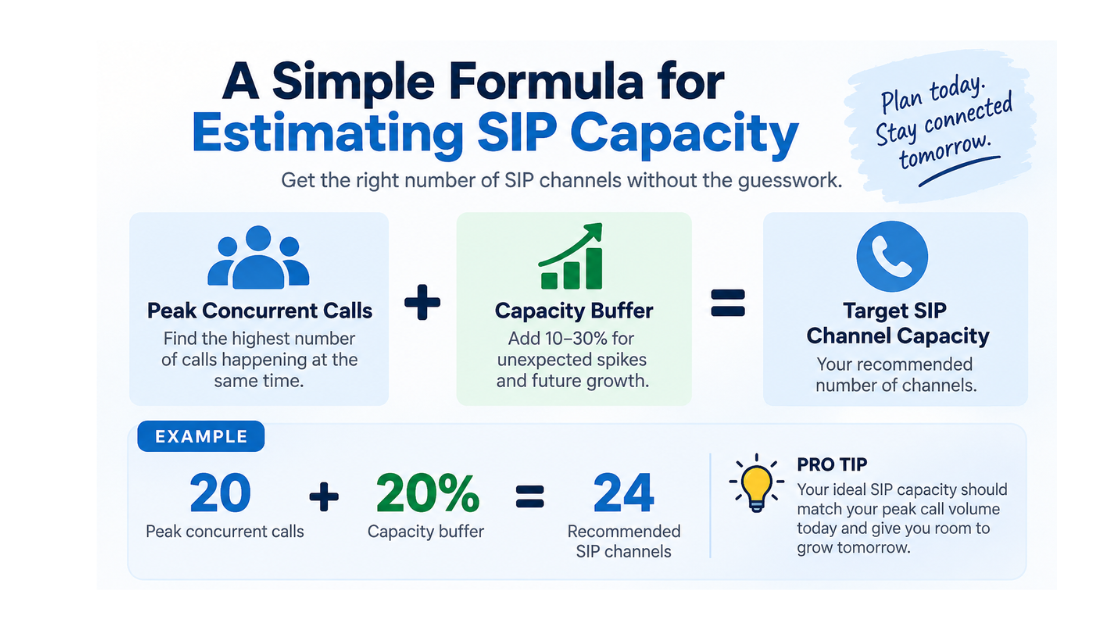
Use this simple formula:
Peak concurrent calls + capacity buffer = target SIP channel capacity
For example:
20 peak calls + 20% buffer = 24 channels
This gives you a practical starting point.
For larger or more complex environments, however, your SIP provider can help analyze call traffic and recommend an appropriate capacity.
Why Choose DIDforSale for SIP Trunking?
Once you know your required capacity, the next step is choosing a provider that can support your business.
DIDforSale SIP Trunking is designed to connect SIP-enabled PBX systems with the public telephone network.
The service supports SIP-enabled PBX systems, number porting, E911, CNAM, and multiple phone number options. DIDforSale also states that its SIP trunking service can support businesses with multiple locations.
Furthermore, DIDforSale provides account management tools that allow customers to manage SIP trunks, phone numbers, and call records through its web portal.
Businesses can also review the SIP configuration documentation when setting up a compatible PBX.
The Bottom Line
So, how many SIP trunks do I need?
The answer starts with one number: your peak concurrent calls.
Do not simply count your employees. Instead, look at how many people are likely to be on calls at the same time.
Then, add a reasonable capacity buffer for unexpected traffic and future growth.
A small office may need only a handful of channels. A growing sales team could need dozens. Meanwhile, a busy call center may require significantly more.
Ultimately, the right SIP trunk capacity depends on how your business actually uses its phone system.
The good news is that SIP trunking can scale with you. As your workforce and call volume change, you can adjust your capacity instead of rebuilding your entire phone infrastructure.
Need help planning your SIP capacity? Start by checking your busiest calling periods and identifying your highest number of simultaneous calls. That figure gives you a practical starting point for choosing the right SIP channel capacity.