If you’ve typed “monthly SIP trunking cost” into Google more than once this week, you’re not alone. Businesses switching from traditional phone lines to SIP trunking almost always land on the same question: what’s this actually going to cost me every month?
The honest answer is — it depends on how you use your phone lines. But that’s not a very satisfying answer, so let’s break down exactly what goes into your monthly SIP trunk bill, what the real numbers look like in 2026, and how to avoid overpaying for capacity you don’t need.
What Is SIP Trunking, Quickly
SIP trunking replaces old-school physical phone lines with a virtual connection that routes voice calls over the internet straight into your existing PBX or phone system. No copper wiring, no per-line hardware, no landline contracts. Just a SIP trunk connecting your business to the public phone network.
Because it’s virtual, SIP trunking is priced very differently than legacy telecom. Instead of paying a flat fee per physical line, you’re typically paying based on usage, channels, or a combination of both — which is exactly why the monthly cost varies so much from business to business.
SIP Trunking vs Traditional Phone Lines: The Ultimate Battle
The Real Factors Behind Your Monthly SIP Trunking Cost
Before we get into numbers, it helps to understand what’s actually being billed. A SIP trunk pricing guide worth its salt should cover these five cost drivers:
1. Call Volume
More outbound minutes = more usage-based cost. A 5-person sales team making short calls all day looks very different, cost-wise, from a 200-agent call center running back-to-back conversations.
2. Channels (Concurrent Call Capacity)
A “channel” is one simultaneous call. If you need 10 people on the phone at once, you need 10 channels. Channels are usually the backbone of your fixed monthly cost, separate from usage.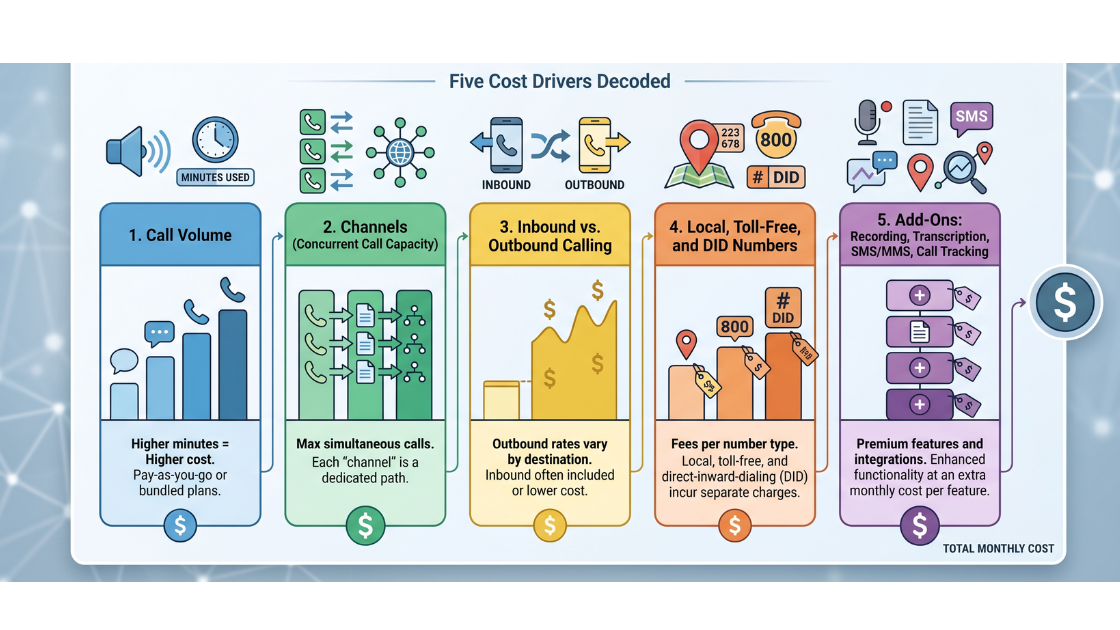
3. Inbound vs. Outbound Calling
Inbound and outbound minutes are often priced differently. Some plans bundle unlimited inbound while charging per-minute for outbound, which can dramatically change your monthly SIP trunking cost depending on your call direction mix.
4. Local, Toll-Free, and DID Numbers
Every phone number attached to your trunk — local DID, toll-free, or vanity — usually carries its own small monthly or per-number fee.
5. Add-Ons: Recording, Transcription, SMS/MMS, Call Tracking
Modern SIP trunking isn’t just voice anymore. Call recording, AI transcription, business texting, and call tracking are common add-ons that show up as line items on your invoice.
SIP Trunk Cost Explained: The 2026 Numbers
Let’s put real figures behind this. Based on current 2026 SIP trunking pricing structures, here’s roughly what businesses should expect to budget for, broken down by service type.
Pay-As-You-Go Voice
For businesses with unpredictable or lower call volume, per-minute pricing starts as low as $0.0025–$0.004 per minute, with no monthly commitment required at the entry tier. This is often the best monthly SIP trunking cost option for smaller teams that don’t want to commit to a fixed spend every month.
Unlimited Inbound Plans
If your business takes far more calls than it makes, an unlimited inbound plan removes per-minute anxiety on incoming traffic. These plans are typically priced per channel, in the range of $6.99–$8.99 per channel per month, with outbound still billed pay-as-you-go.
Toll-Free Numbers
Toll-free lines usually carry a small monthly number fee (around $1–$3 per toll-free number) plus a per-minute rate in the $0.015–$0.019 range, depending on volume commitment.
Local DID Numbers
Local phone numbers are one of the cheapest line items on a SIP trunk invoice, generally running $0.25–$1.00 per number per month depending on volume tier.
Business Texting (SMS/MMS)
Since most SIP numbers today are SMS-enabled, texting costs are usually billed separately at roughly $0.004–$0.005 per SMS and $0.012–$0.015 per MMS.
Call Recording & Transcription
Add-on services like call recording run as low as $0.0015 per minute, plus storage fees per GB, while AI-based call transcription typically costs $0.025–$0.035 per minute.
Unlimited/Fixed-Cost SIP Trunks
For businesses that want zero surprises on their bill, fixed monthly SIP trunking plans bundle unlimited outbound calling to the US and Canada, sized by the number of concurrent channels you need — a predictable, worry-free monthly SIP trunking cost model.
Hosted PBX
For companies wanting a fully managed cloud phone system bundled with their trunking, hosted PBX pricing generally starts around $9.99 per user per month, with unlimited calling and dozens of built-in features included.
Putting Together Your Monthly SIP Trunking Cost Estimate
Here’s a simple way to estimate your own SIP trunk cost before committing to a plan:
- Count your concurrent call needs. How many people realistically need to be on a call at the same time during peak hours? That’s your channel count.
- Estimate monthly minutes. Add up your average outbound and inbound minutes per month.
- Tally your numbers. How many local, toll-free, or vanity numbers do you need active?
- Decide on add-ons. Do you need call recording for compliance? Transcription for QA? SMS for customer outreach?
- Match volume to commitment tier. Higher monthly spend commitments almost always unlock lower per-minute and per-channel rates — so businesses with steady, predictable volume can meaningfully lower their SIP trunk pricing by opting into a higher commitment tier.
A small business making a few hundred calls a month might land well under $50/month in pure trunking costs. A growing call center running dozens of simultaneous conversations, with recording and transcription enabled, could be several hundred to a few thousand dollars a month — but still a fraction of what legacy PRI lines would cost for the same capacity.
Why Monthly SIP Trunking Costs Are Dropping in 2026
Cloud communication infrastructure keeps getting cheaper to operate, and that savings has trickled down to businesses. Compared to just a few years ago, per-minute rates, per-channel pricing, and add-on services like transcription have all become more competitive as more providers compete for volume-based business. If you haven’t priced out SIP trunking recently, 2026 rates are very likely lower than what you remember.
Final Thoughts
There’s no single number that answers “how much does SIP trunking cost per month” — and that’s actually a good thing. It means you’re not stuck overpaying for a fixed legacy line package that doesn’t match your call patterns. Whether you need pay-as-you-go flexibility, unlimited inbound peace of mind, or a fully managed hosted PBX, your monthly SIP trunking cost should scale with how your business actually communicates — not the other way around.
Ready to see exactly what your business would pay? Explore DIDforSale’s transparent SIP trunk pricing plans and get a real quote in minutes.