You’re running paid search campaigns, optimizing landing pages, and A/B testing ad copy. Then your client calls and asks, “So where are these leads actually coming from?” Sound familiar?
For marketing agencies handling multi-channel campaigns, the gap between digital clicks and real phone conversations is a massive blind spot. You might know which ad drove a form fill. However, do you know which campaign triggered a high-value call that turned into a $10,000 contract?
That’s precisely where call tracking for marketing agencies changes everything. In this guide, we’ll break down what call tracking means, how it improves lead quality, and why agencies without it are leaving revenue intelligence on the table.
What Is Call Tracking — And Why Should Your Agency Care?
Call tracking assigns unique phone numbers to specific marketing channels, campaigns, ad groups, or keywords. When a prospect dials one of these numbers, the system records which touchpoint generated that call. As a result, your agency gets granular, channel-level attribution for every inbound phone lead.
Think of it as UTM parameters — but for phone calls. Instead of simply seeing “organic search drove 200 sessions,” you can now see “organic search drove 47 calls, and 31 lasted over 3 minutes.” That’s your highest-quality lead signal.
Modern platforms like DIDforSale offer:
- Dynamic Number Insertion (DNI) to track calls by digital source in real time
- Static numbers for offline channels like billboards, print, and TV
- Call recording and transcription for quality scoring
- CRM and analytics integrations for closed-loop reporting
- Keyword-level attribution connecting Google Ads clicks to actual calls
The Lead Quality Problem Most Agencies Don’t See Coming
Here’s the uncomfortable truth: not all leads are created equal. Furthermore, volume-focused reporting is quietly destroying your agency’s credibility with clients.
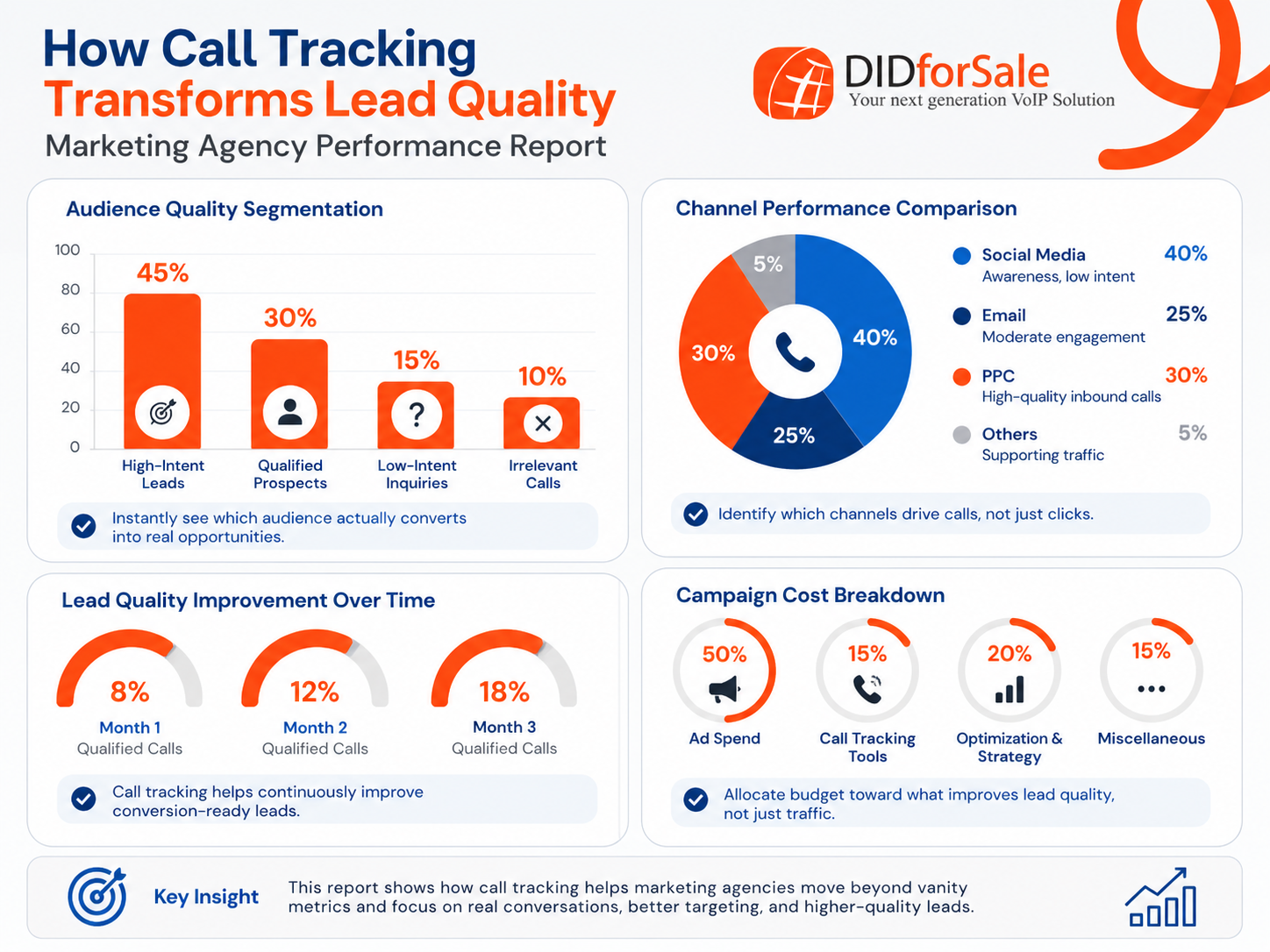
Consider this scenario. You’re running Google Ads for a dental practice. Campaign A generates 150 form fills at $12 CPL. Meanwhile, Campaign B generates 40 phone calls at $45 CPL. On paper, Campaign A looks like the winner. But when you study the call data, Campaign B leads convert at 60%. Campaign A leads, on the other hand, are mostly people asking about directions or insurance. In other words, Campaign B is generating 5x the revenue per dollar spent.
Without call tracking for marketing agencies, this insight stays completely hidden. As a result, you optimize for cheap leads rather than profitable clients.
📊 Key Insight: Phone calls convert to revenue 10–15x more than web leads alone. For service businesses, inbound calls are often the highest-intent touchpoint in the entire customer journey.
5 Ways Call Tracking Benefits for Agencies Are Immediate and Measurable
1. True Multi-Channel Attribution
Once you track phone call conversions alongside form fills and chat interactions, the full picture emerges. You can finally see which channels drive real business — not just clicks. DIDforSale integrates with Google Analytics 4, Google Ads, Facebook Ads, and your CRM. Consequently, you can attribute revenue to the exact keyword or campaign that triggered the call.
2. Smarter Budget Reallocation
One of the strongest call tracking benefits for agencies is cutting spend from channels that look good on paper but don’t generate quality calls. For example, when you can show a client “We shifted $3,000/month from display to paid search based on call data and your revenue-per-lead jumped 43%,” you become indispensable. Moreover, those conversations are hard for competitors to replicate without the same data.
3. Lead Scoring with Real Conversation Data
Call duration, outcomes, and keyword triggers all become powerful scoring inputs when you improve lead quality with call tracking. A call under 30 seconds is likely a wrong number. However, a 4-minute call from someone who searched “emergency HVAC repair near me” is a red-hot lead. Feeding this back into your bidding strategy means campaigns grow smarter with every call.
4. Client Retention Through Undeniable ROI Proof
Churn is the silent killer for agency growth. When clients don’t see clear, attributable ROI, they question the retainer. Fortunately, call tracking gives you the receipts. You can walk into every monthly review with a statement like: “Your campaigns generated 87 qualified calls this month at $34 per call. Your team closed 29 — at a $650 average transaction value, that’s $18,850 in tracked revenue.” No more vague impressions. Revenue attribution is your strongest client retention tool.
5. Competitive Intelligence Through Call Monitoring
Call recordings and AI transcriptions give agencies a goldmine of qualitative insight. Specifically, you can identify common objections, frequent questions, and the exact language buyers use when ready to purchase. This intelligence then flows into ad copy improvements, landing page updates, and sales training. In short, it creates a compound value loop no competitor without call data can match.
How to Track Phone Call Conversions: A Practical Agency Framework
Getting started doesn’t require an IT overhaul. In fact, most agencies deploy this for any client in under a week:
Step 1 — Audit inbound channels: First, identify every touchpoint that could generate a call — Google Ads, organic search, social, email, print, and referrals.
Step 2 — Assign unique tracking numbers: Next, use DIDforSale’s virtual number provisioning to get dedicated DIDs for each campaign or channel group.
Step 3 — Implement Dynamic Number Insertion: After that, a small JavaScript snippet automatically swaps the phone number displayed on the site based on the visitor’s traffic source.
Step 4 — Connect your analytics stack: Then integrate with Google Analytics 4, your CRM, and ad platforms so call events appear alongside other conversion data.
Step 5 — Define a “quality call”: Set minimum duration thresholds, tag call outcomes, and build custom conversion events for high-intent calls only.
Step 6 — Feed data back into campaigns: Finally, use call conversions as your primary bidding signal in Google Ads Smart Bidding. Watch cost-per-acquisition drop as the algorithm learns which combinations drive real buyers.
Why DIDforSale Is Built for Marketing Agency Workflows
Most call tracking platforms are built for single businesses. As a result, multi-client management becomes clunky, number provisioning slows down, and reporting turns rigid.
DIDforSale’s call tracking for marketing agencies is built differently. As a carrier-grade VoIP and DID provider, we offer:
- Instant number provisioning across local, toll-free, and vanity numbers in 40+ countries
- White-label reporting dashboards you can brand for client-facing use
- API-first architecture for custom integrations with any CRM or ad platform
- Bulk number management to handle dozens of accounts from a single portal
- Competitive per-minute pricing with no long-term contracts
- 99.99% uptime SLA — because missed calls mean missed revenue
Whether you manage 5 clients or 500, working with a single provider for DIDs, call tracking, SIP trunking, and analytics is a real competitive advantage.
Real-World Impact: What Agencies Report After Enabling Call Tracking
Agencies that integrate call tracking into their analytics workflows consistently report strong results. Specifically, they see:
- 30–50% reduction in wasted ad spend after cutting underperforming channels
- 2–4x improvement in reported client ROI once phone conversions are counted
- Higher client retention tied to clearer, more defensible monthly reporting
- Faster optimization cycles because call data is richer than form fills alone
- New upsell opportunities — clients who see call ROI data increase budgets more readily
The Bottom Line: Track Every Conversion or Leave Revenue Behind
The phone call is alive and thriving — especially in healthcare, legal, home services, finance, and real estate. If your agency runs campaigns for any of these industries without tracking phone call conversions, you’re working with an incomplete picture. Worse, you’re optimizing toward the wrong outcomes.
Call tracking for marketing agencies is not a nice-to-have. Rather, it’s a foundational capability for any agency serious about ROI, client retention, and performance in today’s marketing landscape.
DIDforSale makes it simple. Get the numbers, deploy the tracking, close the attribution loop, and start having data-backed conversations that turn retainers into long-term partnerships.
🚀 Ready to improve lead quality with call tracking?
Explore DIDforSale’s call tracking solutions built for marketing agencies. Get instant access to virtual numbers, real-time call analytics, and seamless integrations — no long-term contracts required.
Related Blogs
Dynamic Number Insertion in Call Tracking: The Complete Guide for Businesses
How Call Tracking Software Works in 2026
Call Tracking for Small Businesses: A Low-Cost Setup Guide
Privacy & Compliance in Toll-Free Call Tracking: What You Must Know
Why Every Business Should Invest in a Call Tracking System
Account-Based Marketing Enhanced: How Call Tracking Boosts Lead Scoring and Conversions
The Role of AI in Modern Call Tracking Solutions
How Businesses Can Benefit from Call Tracking Software?
Call Tracking App vs. Traditional Call Monitoring
Use Phone Call Tracking Software to Analyze Sales Calls